

Debussy "La Mer": Music That Never Tried to Sound Like the Sea
Listen to this article
Debussy's La Mer L.111 (1903–05) is not music about the sea. At least, it is not music that attempts to reproduce the sea in sound.
Written from Memory
In the summer of 1903, Debussy began composing La Mer in the Burgundy countryside — deep inland, far from any coast. In a letter to his publisher Durand, he wrote:
I am trying to finish it here, working from countless memories (d'innombrables souvenirs).
— Debussy, letter to Durand, 1903
Rather than writing while listening to the actual sea, he was writing from his memory of it. This was no accident. In a letter to his friend André Messager, he explained:
But I have countless memories; this is worth more in my view than a reality whose charm generally weighs too heavily on one's thought.
— Debussy, letter to Messager, 12 September 1903
To evoke an inner experience of the sea rather than to transcribe it — this idea runs through the entire method of La Mer.
The work's original title was Mer belle aux Îles Sanguinaires. It was eventually simplified to La Mer.
The Wooden Nightingale
Debussy had this to say about Beethoven's Symphony No. 6, "Pastoral":
Watching the sunrise is more useful than hearing the Pastoral Symphony.
— Monsieur Croche (the persona Debussy used for his music criticism, beginning in 1901)
In the same critique, he went further:
Look at that scene by the brook — a brook where cows apparently come to drink. Not to mention the wooden nightingale and the Swiss cuckoo.
— Monsieur Croche
What Debussy objected to was the technique of having instruments imitate birdsong, or timpani reproduce thunder. Music had become a substitute for natural sounds — and that was precisely his quarrel with it.
What Debussy wanted was not to reproduce the sounds of the sea, but to evoke the inner experience of someone near the sea: the shifting light, the movement of water, the passage of time. Not realism, but the capture of impression.
The titles of La Mer's three movements name time and phenomenon, not scenes — "From Dawn to Noon on the Sea," "Play of the Waves," "Dialogue of the Wind and the Sea." Nothing is written about what the listener should feel.
Debussy called the work "three symphonic sketches." Not a symphony, not a symphonic poem. The word sketch is a term from painting: not a finished depiction, but the capture of an impression.
To Suggest, Not to Explain
Debussy was deeply devoted to Wagner in his youth. He made the pilgrimage to Bayreuth in 1888 and 1889. But over time, he grew to see the limits of Wagner's leitmotif technique — attaching musical symbols to characters, concepts, and emotions, then layering them with precision to narrate a story. Music functioning as a device for conveying meaning: that was his doubt.
In 1903 — the very year he began La Mer — Debussy wrote:
Wagner was a beautiful sunset that was mistaken for a dawn.
— Debussy, 1903
It is entirely consistent, then, that Croche reserved his highest praise for Parsifal:
In Parsifal, Wagner tried to be less harshly authoritarian with music; it breathes more freely there.
— Monsieur Croche
One hears unique, unexpected, noble and strong orchestral sonorities. It is one of the most beautiful sonic monuments ever raised to the imperturbable glory of music.
— Monsieur Croche
The work in which music was most free from the obligation to carry symbolic meaning was the one Debussy praised most highly. His admiration for Parsifal was also, in outline, a description of what he himself was aiming for.
What Debussy sought was music that would suggest rather than explain an image — that would not narrate but drift. La Mer has no leitmotifs. No symbols stand for the sea. What it has is texture, color, and a sense of movement.
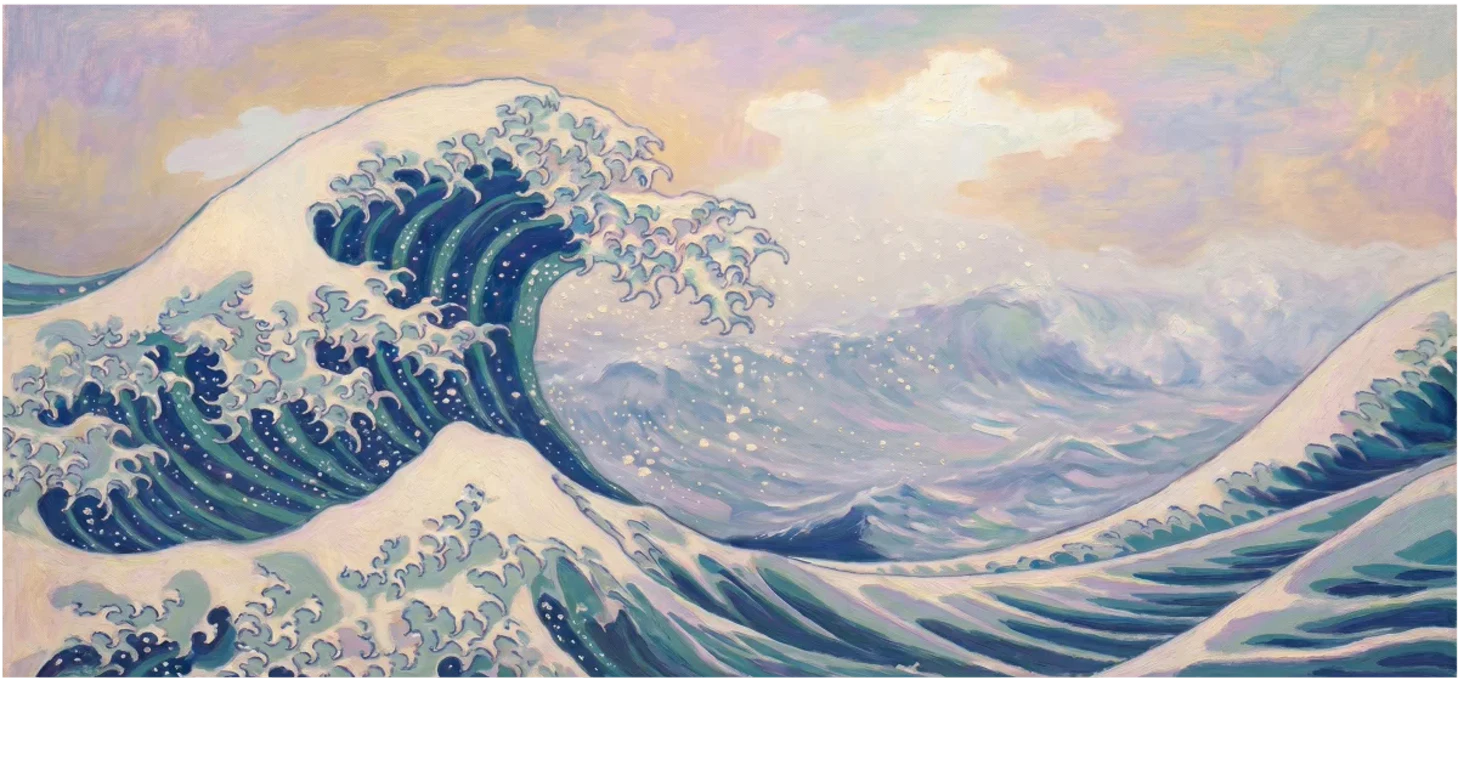
For the cover of the first published score in 1905, Debussy chose Hokusai's The Great Wave off Kanagawa — a print he had kept on the wall of his studio for years. Hokusai's original composition holds the churning wave in the foreground and the stillness of Mount Fuji in the distance — a contrast of motion and repose. But the image Debussy used on the score was a cropped version with Fuji removed. Not a landscape, but the force and movement of the wave itself.
The Same Problem, Different Answers
Saint-Saëns was also calling for French music to reclaim its independence from German influence. The Franco-Prussian War had ended the year before Debussy was born; the following year, 1871, Saint-Saëns founded the Société nationale de musique to cultivate a distinctly French musical tradition. Debussy himself joined the society in 1888, and the premiere of his Prélude à l'après-midi d'un faune took place there in 1894. On that level, the two composers shared a common cause.
Yet Croche wrote this:
M. Saint-Saëns is the man who knows music better than anyone in the world. He championed the tumultuous genius of Liszt and spread devotion to old Bach. How is it possible for him to go so completely astray?
— Monsieur Croche
It sounds like irony, but the bewilderment here is genuine. Where did they diverge?
Saint-Saëns pursued French expression within the traditional forms of Western music — the symphony, the concerto — trusting those forms and seeking freedom inside them.
Debussy's objection was to the forms themselves. Forms carry emotional templates: symphonies have certain trajectories, certain climaxes, certain resolutions — and going through those gestures by rote was what Debussy meant by sentimentality:
I have a horror of sentimentality! But I wish I did not have to remember that his name is Camille Saint-Saëns.
— Monsieur Croche, Monsieur Croche, antidilettante (1921)
For Debussy, breaking from German music was not merely a question of style. It was a question of what music exists to do. Not to work within inherited forms and their built-in emotional expectations, but to express sensation, color, and texture directly in sound. That is why he chose "symphonic sketches" — not "symphony," not "symphonic poem."
The story of Saint-Saëns walking out of the 1902 premiere of Pelléas et Mélisande — seeing a work without melody or form where Debussy saw liberation from form — captures the distance between them.
The Echo of Gamelan
At the 1889 Paris Exposition, Debussy encountered Javanese gamelan and returned to its performances repeatedly. Years later, he wrote:
Think of the Javanese music, which contained every nuance, even those one cannot name. There, the tonic and dominant had become empty phantoms, useful only for a naughty child who refuses to understand.
— Debussy, c. 1895
Music in which the tonic and dominant — the twin pillars of Western harmonic thinking — were mere ghosts. Gamelan was, for Debussy, an experiential proof that the framework of Western form and harmony was not a given.
In the opening of La Mer's first movement, the strings build up layers of small figures while the bass maintains an independent, unhurried motion. Multiple rhythmic layers run simultaneously, none taking precedence. The heterophonic textures Debussy discovered in gamelan are alive here, inside a full orchestra.
"I Cannot Hear the Sea" — The Critics React
The premiere was on 15 October 1905, with the Orchestre Lamoureux in Paris. The reviews were harsh.
Pierre Laro — who had once championed Pelléas et Mélisande — wrote in Le Temps:
I can neither hear the sea, nor see it, nor smell it.
— Pierre Laro, Le Temps, 1905
Another critic called it "water swirling in a dish."
What these reviews inadvertently reveal is that audiences expected to hear the sea in the music — the crash of waves, the roar of a storm, the kind of natural-sound reproduction found in the Pastoral Symphony. But that is not what Debussy had written. He was not imitating the sounds of the sea; he was trying to evoke what a person near the sea actually feels. The gap between that intention and those reviews is contained in the phrase "I cannot hear the sea."
The turning point came on 19 January 1908, when Debussy himself stepped onto the podium — picking up a baton for the first time in his life at the age of forty-five. The performance was met with a standing ovation, and La Mer began its life as a repertoire standard across Europe.
Sources
- Debussy, Claude. Lettres de Claude Debussy à son éditeur. Paris: A. Durand et fils, 1927.
- Debussy, Claude. L'enfance de Pelléas: lettres de Claude Debussy à André Messager. Ed. Jean-André Messager. Paris: Dorbon-aîné, 1938.
- Debussy, Claude. Monsieur Croche, antidilettante. Paris: Librairie Dorbon-Aîné, 1921.
- Debussy, Claude. Debussy Letters. Selected and ed. François Lesure and Roger Nichols. Trans. Roger Nichols. Cambridge, MA: Harvard University Press, 1987.
- Debussy, Claude. Correspondance, 1872-1918. Éd. François Lesure and Denis Herlin; annot. François Lesure, Denis Herlin, and Georges Liébert. [Paris]: Gallimard, 2005.
- Yasuda, Kyo. "Debussy and Javanese Gamelan." Ongaku Hyōgengaku 5 (2007)