

Shostakovich Symphony No. 7 "Leningrad" — Satire, Heroic Hymn, or Something Else
Listen to this article
A simple, memorable melody is repeated, swelling gradually. The most famous piece built on this overall structure is Ravel's Boléro, but the so-called "invasion theme" from the first movement of Shostakovich's Symphony No. 7 is no less well known. Since its premiere, this work has accumulated layer upon layer of interpretation and critical assessment.
The Invasion Theme
A short, accessible, easily-remembered melody is repeated mechanically, with a snare drum marking time in a military-march manner. With each repetition, more instruments are layered in, and the volume rises in stages.
Shostakovich himself was aware of the structural resemblance to Boléro. In August 1941, after playing his newly composed first movement to Isaak Glikman, he is reported to have said:
I don't know what will become of this piece. Idle critics will surely rebuke me for imitating Boléro. Well, let them — that is how I hear the war.
— Shostakovich, August 1941, via Glikman (Taruskin 1997, p.486)
The Siege of Leningrad: Reception as Anti-Nazi Music
Shostakovich's Symphony No. 7 in C major, Op. 60 ("Leningrad"), is a four-movement symphony completed during the Second World War — specifically during Nazi Germany's invasion of the Soviet Union, and more specifically during the siege of Leningrad.
In 1941, having broken the Nazi-Soviet non-aggression pact and launched the invasion of the USSR, Hitler's regime set out to take Leningrad (present-day Saint Petersburg), the Soviet Union's second-largest city and a major industrial center. German armored divisions advanced rapidly and reached the outskirts of Leningrad in short order, but in view of Soviet defensive lines and the projected attrition of urban combat, Germany opted for a war of siege and slow attrition.
The siege began in September 1941, and combined with heavy bombardment, food supplies in the city ran out almost at once; by December the city had fallen into full-scale famine. Despite limited supplies via Lake Ladoga to the north (which froze in winter, allowing crossings) and small-scale airlifts, these were a drop in the bucket. Nearly a million civilians are said to have died of starvation.
Shostakovich was in Leningrad at the outbreak of the war. Amid the intensifying German bombardment, he served as a volunteer firefighter, but he was eventually evacuated by the authorities — first to Moscow, then to Kuybyshev (now Samara), the wartime provisional capital. The "official story" holds that he wrote the symphony in the heat of war, driven by anger at the German invaders and a desire to rouse his fatherland; but some biographical studies indicate that the material for the first movement was already in development before the war. In any case, the work was in fact completed at his place of evacuation, Samara (Kuybyshev).
The symphony runs about 75–80 minutes. Each movement was originally given a subtitle: I. "War"; II. Scherzo "Memories"; III. "The Wide Spaces of the Fatherland"; IV. "Victory." Some accounts suggest that Shostakovich later wished these subtitles removed.
The premiere took place in March 1942 in Kuybyshev, and the work was broadcast nationally as a symbol of the indomitable Soviet spirit standing against fascism — used to massive effect as state propaganda. In August of the same year, it was also performed in besieged Leningrad itself.
Reception outside the Soviet Union, too, was less a matter of spontaneous enthusiasm than a stage carefully set by wartime publicity needs. According to Taruskin, Shostakovich's autograph score was microfilmed and flown by allied military transport "by way of Teheran, Cairo, and Buenos Aires" to New York, where Arturo Toscanini led the U.S. broadcast premiere on 19 July 1942 amid what Taruskin describes as "war-hysterical publicity" (Taruskin 1997, p.484). The audience numbered in the millions, and Mr. and Mrs. Stravinsky, in Hollywood, are recorded in Mrs. Stravinsky's diary as having stayed home to listen. Toscanini had fought Stokowski for the U.S. premiere rights; in a letter to Stokowski he pressed the case: "I was deeply taken by its beauty and its anti-Fascist meaning. … My dear Stokowski, wouldn't it be interesting for everyone, and for you too, to hear the old Italian conductor (= Toscanini himself, one of the first artists to have fought against Fascism) play this work of a young Russian anti-Nazi composer?" TIME magazine put Shostakovich on the cover of its 20 July 1942 issue, in a fireman's helmet styled after an ancient warrior's, with the burning city as backdrop.
In short, the Seventh was launched into the world from both the Soviet Union and the Western Allies — in the USSR as the symbol of "the unbreaking Soviet people against fascism," in the Allied countries as "the sonic emblem of anti-Nazi, anti-fascist resistance" — almost in parallel, on a foundation of reception that had been politically prepared.
The Cold War and the Thaw: Reception as Covert Critique of the Stalinist System
While the Seventh was publicly trumpeted as anti-invasion music, in the postwar era — particularly during the Cold War and from the 1990s onward — another reading has been repeatedly advanced: that the "invasion theme" can be heard as satire directed not only at the Nazis, but at the Stalinist system itself, perhaps even more pointedly. As Taruskin lays it out, this reading now occupies one of the central positions in international Shostakovich interpretation, and indeed in Russian interpretation after the collapse of the USSR (Taruskin 1997).
By way of biographical background: it is well known that Shostakovich, after his prewar avant-garde works drew Stalin's fury and many of those close to him were purged one after another, voluntarily withdrew his Fourth Symphony from rehearsals. The subsequent Fifth Symphony, however, won lavish praise from the authorities and restored his standing; later scholars came to point out its duality, rereading the major-mode "victory" of the finale as "a parody of forced rejoicing." Esti Sheinberg writes of the violins' obstinate hammering of a single pitch as being "like nails driven into the brain" (Sheinberg 1998). The technique of placing on the surface the idiom demanded by the regime while embedding another meaning inside that idiom — what scholars have called "double-voiced discourse" or "Aesopian language" — has come to be discussed as the strategy that runs through Shostakovich's middle and later compositional career.
Many commentators have tried to read the Seventh along the same lines. Among the statements attributed to Shostakovich himself, in a letter to his close friend Isaak Glikman, after playing through the development of the first movement and "the theme that represents the fascist invasion," he is recorded as saying:
There is no shortage of those dreary critics who conclude I was driven solely by hatred of Hitler when I composed this.
— Shostakovich, in Glikman (ed.), Story of a Friendship (2001)
This is most often read as suggesting that, while he set the "fascist invasion" to music, the "fascism" in question is not limited to Hitler's Nazi Germany. Esti Sheinberg, in Irony, Satire, Parody and the Grotesque in the Music of D. D. Shostakovich (1998), argues — citing the testimony of Shostakovich himself and his son Maxim — that the satire of the invasion theme reaches the "stupid order" of both regimes — Nazism and Stalinism — taken together (Sheinberg 1998).
A more direct statement is preserved in the unpublished notes of Flora Yasinovskaya, a neighbor of the Shostakoviches in Kuybyshev, in which Shostakovich is said to have spoken the following words (the Soviet music theorist Lev Mazel later made the notes public, and Taruskin quotes them):
Fascism is not simply Nazism. This is music about terror, slavery, spiritual exhaustion. The Seventh (and the Fifth) are not just about fascism, but about our system, and about all tyranny and totalitarianism in general.
— Shostakovich, via Mazel via Yasinovskaya's unpublished notes (via Taruskin 1997)
If we take the phrasing "not just about" and "in general" seriously, this reads not as excluding the Nazis, but as opening the meaning of the work onto a wider object that includes Nazism — namely, all forms of tyranny and totalitarianism, the Stalinist system included.
That said, we should keep in mind that one of the principal bases for this Stalin-critique reading is the testimony in Volkov's Testimony (1979), the credibility of which has been questioned from the moment of its publication. For example, in Volkov's book we find the statement "I wrote my Seventh Symphony, the 'Leningrad,' very quickly. … From the first days of the war I sat down at the piano and started work" (a passage Fay identifies as a verbatim copy of a 1939 article by Shostakovich), followed within a page by the contradictory statement "The Seventh Symphony had been planned before the war and consequently it simply cannot be seen as a reaction to Hitler's attack. The 'invasion theme' has nothing to do with the attack. I was thinking of other enemies of humanity when I composed the theme" (later equated by Volkov with Stalin and his henchmen) — the two passages stand side by side within the same chapter, plainly contradicting one another (Fay 1980). The latter statement has become one of the central pieces of evidence for the post-Volkov reading of the symphony as "anti-Stalinist mimicry," but it is worth bearing in mind that the source itself carries an internal contradiction.
Beyond a Single Interpretation
Taking the above considerations together, a reading begins to emerge in which the "invasion theme" of the first movement of the Seventh is not a simple expression of fury at Nazi Germany, but possesses an ironic structure that puts to music the "stupid order" of both Nazism and Stalinism. Sheinberg's analysis, the testimony of Shostakovich and his son Maxim, the words of Mravinsky — all point in this direction.
But to choose between Nazi-critique and Stalin-critique is still, in the end, to remain inside a single question: "Whom is this music satirizing?" So long as one stays inside that question, the meaning of the Seventh is shut into the single direction of "music as satire."
Even at the level of the composer's own intentions, the available testimony calls for caution. The image of a dissident Shostakovich — secretly burning with anger at the Stalinist system while wearing on the surface a mask of compliance — depends to a great extent on the narrative inaugurated by Volkov's Testimony (1979) and developed thereafter. The credibility of Volkov has been discussed above, and the historical record also confirms that, during the Thaw following Stalin's death and through to the end of the Cold War, there was a real desire to re-narrate the composer in retrospect as a "secret dissident," in keeping with the cultural mood of the moment (Taruskin 1997). It is not possible to assert with finality that his intentions were thoroughly dissident, nor is it possible to assert the opposite — that they were thoroughly compliant. Neither claim can rule out the possibility of having been constructed by later narratives.
There are, on the other hand, certain facts about the surroundings of the work that can be confirmed independently of interpretation.
First, the time and place of its composition. During September to December 1941, when Shostakovich was writing this music, the city of Leningrad — the city where he was born, where he received his musical education, where his First Symphony had been premiered, where he had spent his young and middle adulthood — was under German siege. Food and fuel ran out; in temperatures of thirty below, people collapsed on the streets. Roughly one million civilians ultimately perished from starvation and cold — one of the worst sieges in twentieth-century European history. Leningrad was a special place not only for Shostakovich, but for the entire history of Russian classical music — the Saint Petersburg Conservatory, the Mariinsky Theatre, the place where Tchaikovsky's major works received their premieres, where Russian music since Glinka acquired its modern shape. One cannot say with certainty that these circumstances directly influenced his composing. But one cannot, on the other hand, simply set them out of view and reduce the work to "satirical music with an ironic structure."
Second, the content of how the work was actually received at the time. Following the Kuybyshev premiere in March 1942, the Seventh circulated in parallel — within the USSR as a symbol of "the unbreaking Soviet people against fascism," and in the Allied countries as "the sonic emblem of anti-Nazi, anti-fascist resistance." Most famously, on 9 August 1942, in besieged Leningrad, amid hunger and shelling, the local premiere conducted by Karl Eliasberg was broadcast through loudspeakers both within the city and over speakers aimed at the German lines. Survivors' testimony tells us this performance was received as living proof — "we are still here." Whatever the composer's inner intentions may have been, this is what happened.
In Defining Russia Musically (1997), Richard Taruskin describes the reading by Volkov and Ian MacDonald — that the Seventh is "actually anti-Stalinist mimicry" — as "painful." To pursue an exclusively anti-Stalinist reading, one has to disregard the actual images of combat, the loathsomeness of the invasion episode, and the final victory. His central claim is that the meaning of the Seventh must not be reduced to a single paraphrase. The Soviet-propaganda "anti-fascist heroic music" and the Volkov/MacDonald "anti-Stalinist mimicry" — both are, in his view, the same kind of reductive reading.
Shostakovich himself was averse to such literal interpretations. Taruskin records the composer's reported remark that he "wanted to scream" upon finding critics writing "that in such-and-such a symphony Soviet civil servants are represented by the oboe and the clarinet, and Red Army men by the brass section" (Taruskin 1997, p.542). Shostakovich, in Taruskin's view, was a composer who insisted on keeping the work's latent content latent, and labile. He himself refused to let the work be reduced to a single paraphrase.
Pauline Fairclough's comprehensive reconstruction of Shostakovich's reception in Britain and America, and particularly in the British press, points in the same direction. According to Fairclough, the British and American image of Shostakovich has come to be split into two phases — a pre-Testimony "old" Shostakovich (= dutiful Communist) and a post-Testimony "new" Shostakovich (= hidden dissident) — but this very split was itself constructed within the so-called "Shostakovich debates" of the 1990s, "unparalleled in modern musicology" in their aggressive polemic. If one follows the British reception history she charts in detail, the form of his reception has shifted continuously, deeply entangled with the ideology of the moment: the pre-war era of purely musical criticism; the wartime propaganda reception; the postwar oblivion; the boom of the Thaw and the rise of an "ironic" reading; and, in opposition to it, the genealogy of "traditionalists" who chose to read him as a sincere communist. Nor was it political ideology alone that shaped reception. A second factor was the contemporary musical-aesthetic conflict — between avant-garde modernism and the more traditional audiences and critics who felt at odds with it. The relative conservatism of Shostakovich's musical idiom — that he was not radically innovative — produced, in postwar Britain, a current that read him as a counterweight to "the self-indulgent experimentation of the avant-garde," and underwrote the traditionalists' defense of him. Fairclough's concluding observation is that, among the critics of the 1960s and 70s, those who had no difficulty in seeing Shostakovich at once as a sincere patriot — even a sincere communist — and yet nevertheless heard a note of political satire in his music may have come closer to the truth than either those who denied the satire or those who later insisted on it. They had grasped the "doubleness" of both Shostakovich's music and his role in Soviet society — and for that alone. Now that the polarized debate of the 1990s has, she suggests, burnt itself out and is being replaced by a more nuanced, more carefully informed approach, this same "doubleness" is once again being discussed (Fairclough 2007).
The "Shostakovich debates" are not a thing of the past. The polemic, which reached its peak in the 1990s, has continued into the 2000s (Fairclough 2007). What is needed, in place of the simplified dichotomies of "satire or heroic hymn," "anti-Nazi or anti-Stalinist," is the suppleness to hold these readings together without forcing them to exclude one another. On that footing, in the absence of any fixed "correct" answer, each listener may imagine for themselves while listening. That too is, in all probability, permitted.
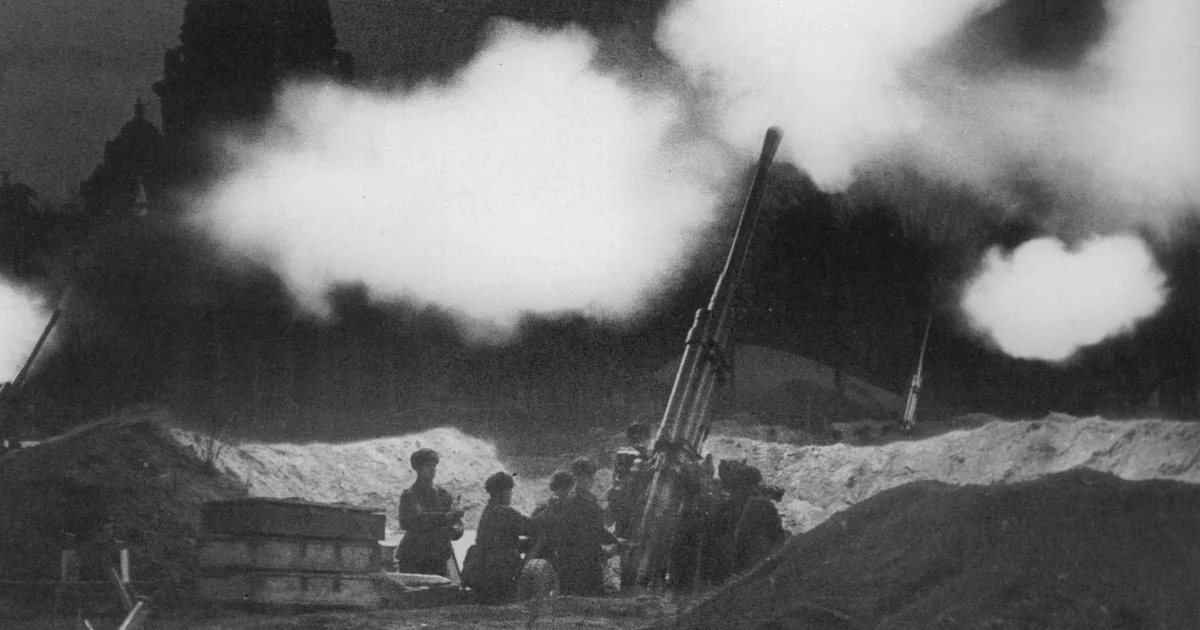
Cover image: Photo by Boris Kudoyarov (1941) / Via Wikimedia Commons
Sources
- Esti Sheinberg, Irony, Satire, Parody and the Grotesque in the Music of D. D. Shostakovich (Ashgate, 2000) — originally a PhD dissertation (Edinburgh, 1998)
- Richard Taruskin, Defining Russia Musically: Historical and Hermeneutical Essays (Princeton University Press, 1997)
- Isaak Glikman (ed.), Story of a Friendship: The Letters of Dmitri Shostakovich to Isaak Glikman, 1941–1975 (Cornell University Press, 2001)
- Laurel Fay, "Shostakovich versus Volkov: Whose Testimony?" Russian Review 39/4 (1980), pp. 484–493
- Pauline Fairclough, "The 'Old Shostakovich': Reception in the British Press," Music & Letters 88/2 (May 2007), pp. 266–296
- Solomon Volkov, Testimony: The Memoirs of Dmitri Shostakovich (Harper & Row, 1979) — cited as a secondary source whose authenticity is disputed
- Ian MacDonald, The New Shostakovich (Northeastern University Press, 1990) — critically cited by Taruskin and Sheinberg